From Shopfront to Front Door: Due Diligence on a High Street Conversion in 2026
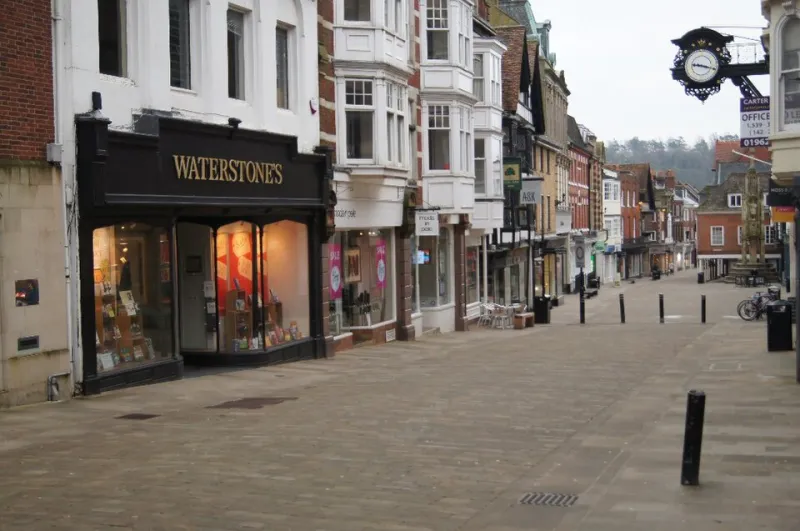
Photo: Fernweh , CC BY-SA 2.0, via Wikimedia Commons
A vacant shop is the most seductive building on the high street. It is usually cheap, usually visible, and usually the subject of a local authority desperate to see something happen. The assumption that follows — that turning it into a home is a change of use and little more — is where a great many otherwise sensible purchases go wrong.
Residential conversion of a former retail unit is permitted development in principle, and has been since Class MA was introduced in August 2021. But permitted development is not the same as automatic, and the matters that can derail a scheme are rarely visible in the estate agent's particulars.
Begin with the use class, not the floor plan
Class E is broad, and deliberately so. It absorbed the old A1, A2, A3, B1 and some sui generis uses, which means a former bank, a former café and a former office can all present identically as an empty unit with a shopfront.
Not everything sits in Class E. Hot food takeaways, betting shops, payday loan shops and launderettes remain sui generis and fall outside Class MA. A unit with a mixed history — a restaurant with an attached flat, a shop with a workshop — needs careful reconstruction of its lawful use before any assumption is made about what can be converted.
The paperwork that matters is the planning history, not the rating list. Ask the authority for the full decision record, and be sceptical of any change of use that was never formally documented.
Class MA: the conditions that decide the case
Three conditions sit at the gateway, and each has an evidence burden.
- Two years in Class E. The building must have been in Class E use, or in a predecessor use, for at least two years before the prior approval application is made. Gaps in the record are the buyer's problem, not the authority's.
- Three months vacant. The unit must have been vacant for at least three months immediately before the application. This sounds trivial and is frequently the weakest link, particularly where a short-term let or a pop-up has quietly occupied the space.
- Floor space. The limit is 1,500 square metres of floor space in the building. Above that, Class MA is unavailable and a full planning application becomes necessary.
Prior approval is not a free pass. The authority must consider transport and highways impacts, noise, contamination, flooding, the provision of adequate natural light in every habitable room, and the effect of losing the commercial use on the provision of essential local services. That last matter is where a conversion in an isolated parade can fail, even when everything else is satisfactory.
The Article 4 direction that overrides everything
No amount of design quality will rescue a scheme caught by an Article 4 direction removing Class MA. Directions of this kind have proliferated in town centres and conservation areas, often expressly to protect retail and employment floorspace. They can be non-immediate, but the ones that bite are frequently in force already.
Checking for an Article 4 direction is a five-minute task and should be the first thing done after reading the title. Authorities publish their directions, and a written confirmation from the planning department is worth obtaining before exchange rather than after.
Retail frontage, town centre policy and the design question
Even where permitted development applies, the character of the street is not irrelevant. Local plans commonly designate primary shopping areas and retail frontages, and policies on ground-floor active use may constrain what can be done at street level. Conversion of the upper floors is usually straightforward; converting the ground floor and losing the shopfront entirely is where policy resistance gathers.
In a conservation area the position is stricter still. Demolition of an unlisted building in a conservation area now requires planning permission in its own right rather than a separate heritage consent, and the effect of a new residential frontage on the area's character will be assessed. Where the building is listed, permitted development does not apply at all and a full application with listed building consent is required. Expect the loss of historic shopfront joinery to be the point of contention.
A practical route that often works: retain a commercially credible ground floor, convert above, and demonstrate that the conversion has been designed rather than merely achieved.
Fire, sound and the rest of the building regulations
A material change of use to dwellings triggers the full weight of the building regulations, and the fire strategy is where budgets are most often misjudged. Flats above commercial premises raise questions about separation, protected escape routes and, on larger buildings, the higher-risk building regime at 18 metres or seven storeys.
Bring a fire engineer in early. Approved Document B requirements for flats are meaningfully harder than for a shop, and a single staircase serving multiple new dwellings can be a genuine constraint rather than a design preference. Sound insulation under Part E, ventilation under Part F and overheating under Part O all apply, and an existing building fabric will rarely meet them without intervention.
The due-diligence checklist before exchange
- Reconstruct the lawful planning use history and confirm two continuous years of Class E use.
- Verify the three-month vacancy period with utility records and inspection notes.
- Confirm the building is below 1,500 square metres of floor space.
- Search the register of Article 4 directions, both adopted and emerging.
- Check conservation area designation, listed status and any heritage partnership agreements.
- Review local plan policies on retail frontages and ground-floor active use.
- Obtain a daylight and sunlight assessment before committing to a layout.
- Commission a fire strategy at feasibility stage, not at building control stage.
- Establish CIL liability and whether any affordable housing threshold or vacant building credit applies.
- Test the exit: ask a valuer and a lender how they view flats above a retail or food unit, particularly where escape is by a single stair.
None of these steps is exotic. Taken together they separate a conversion that is genuinely straightforward from one that will absorb two years and a planning appeal. A vacant shop is an opportunity; it is not a shortcut.