When the Condition Says Farmer Only: Buying, Living With and Untying an Agricultural Occupancy Restriction
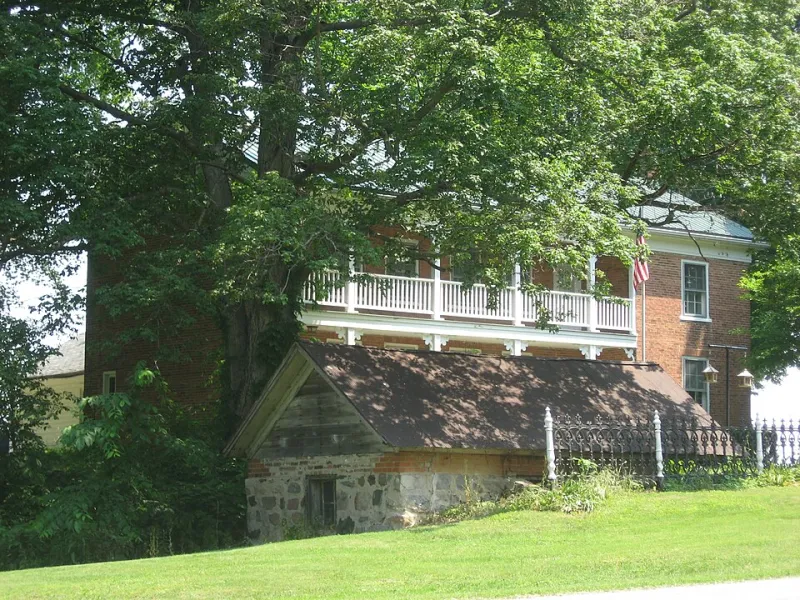
Photo: Nyttend, Public domain, via Wikimedia Commons
The listing said farmhouse, four bedrooms, outstanding views, offers in the region of a figure that seemed too low for the area. The reason was buried in the legal pack: an agricultural occupancy condition, imposed when the dwelling was built in the 1980s and never discharged. Roughly thirty per cent of the value of a comparable unrestricted house, and a mortgage application that stalls at the lender's desk rather than the valuer's.
This is not a rare curiosity. Thousands of dwellings across England carry a condition tying occupation to agricultural or forestry work. Some are genuinely necessary. Others have long outlived the holding that justified them, but remain in force because nobody has gone to the trouble of removing them.
What the condition normally says
The standard wording, drawn from the model condition in long-standing government guidance and still reproduced today, limits occupation to a person solely or mainly working, or last working, in the locality in agriculture as defined by section 336 of the Town and Country Planning Act 1990, or in forestry, or to a widow or widower of such a person, and to any resident dependants.
Four points follow from that wording, and all four are routinely misunderstood.
- The occupier does not have to own the land, and does not have to be employed by a farm business. Genuine self-employment in agriculture can qualify.
- Employment must be more than casual, but the phrase solely or mainly is not a rigid hour count; it is a question of fact and degree.
- Agriculture has a statutory meaning, broad enough to include horticulture, fruit growing, seed growing, dairy farming, livestock, and the use of land as grazing or market gardens, but not, for instance, a livery yard or most equestrian businesses.
- A person who has retired from farming may still qualify under the last working limb, and dependants living with them are covered.
The traps that catch buyers
The first mistake is to read the registered title and stop. The restriction is a planning condition, not a covenant, and it will appear on the decision notice that granted permission. Ask for that notice, and for the full planning history, before any money is committed. A few properties have two conditions, sometimes inconsistently worded. A few carry a Section 106 obligation instead, or as well, which needs a different answer entirely.
The second mistake is to assume a breach is harmless because the council has not acted. Enforcement is discretionary, but the exposure is real: a breach of condition is a breach of planning control, and the authority has ten years in which to act in most cases. After ten years of continuous, evidenced breach, a certificate of lawfulness can be sought — but proving continuous occupation over a decade, with the right documentary trail, is far harder than it sounds. Utility bills and tenancy agreements help; tax returns and employer references help more.
The third mistake is the mortgage. Many high street lenders will not touch a tied dwelling. Those that will often reduce the loan-to-value, and the valuer's report will typically discount the property by a quarter to a third against an unrestricted comparable. That discount is not an overreaction; it reflects a genuinely thinner buyer pool and a longer time to sell. Buyers relying on a small deposit should expect difficulty, and should have a broker identify a lender in principle before paying for searches.
How a council decides whether the tie still earns its keep
The tests are not mysterious. They come down to need and proportionality.
First, is there a continuing need for dwellings restricted to agricultural or forestry occupiers in that locality? That is not answered by asking whether the current owner farms. It is answered by evidence of demand from working farmers and foresters who cannot find suitable accommodation nearby.
Second, is the dwelling appropriate in size and character to the holding it is meant to serve? A six-bedroom house with a paddock rarely reads as essential workers' accommodation.
Third, has the requirement been tested in the market? Almost every authority will expect to see the property offered for sale with the condition intact, at a realistic price that reflects the restriction, for a sustained period — commonly twelve months — advertised through local agents and the farming press, with a record of enquiries. A file showing dozens of viewings and no qualifying offers is the strongest single piece of evidence an applicant can hold.
Alongside that sits an independent rural surveyor's report, addressing the state of agriculture in the area, the demand for tied housing, and the prospects for the holding. Supporting letters from local agents carry weight; unsupported assertions from the owner do not.
The application itself is normally made under section 73 of the Town and Country Planning Act 1990 to vary or remove the condition, and since the introduction of the free-standing variation route under section 73B, it is now possible to bring one where the permission has already been implemented. Where the restriction sits in a Section 106 agreement, the route is a deed of modification negotiated with the authority instead. Refusals are appealed regularly, and inspectors are consistent: the appellant who has done the marketing work wins far more often than the one who simply argues that the condition is inconvenient.
A due diligence checklist
- Obtain every decision notice, not just the title register.
- Confirm whether the restriction is a condition or an obligation, and whether both exist.
- Ask the seller for evidence of how the condition has been complied with.
- Check the ten-year enforcement position and consider a certificate of lawfulness.
- Instruct a lender that is comfortable with restricted occupancy before incurring legal costs.
- Price in the discount and the time-to-sell, not just the purchase price.
None of this makes a tied farmhouse unbuyable. It simply means the property must be bought with the restriction in view, valued on its own terms, and — where the justification has gone — pursued patiently through the planning system rather than assumed away.